
Written by Dr. Shirisha Reddy Varna — Fertility Specialist & Gynecologist, Prana Women and Fertility Hospital, Miyapur, Hyderabad
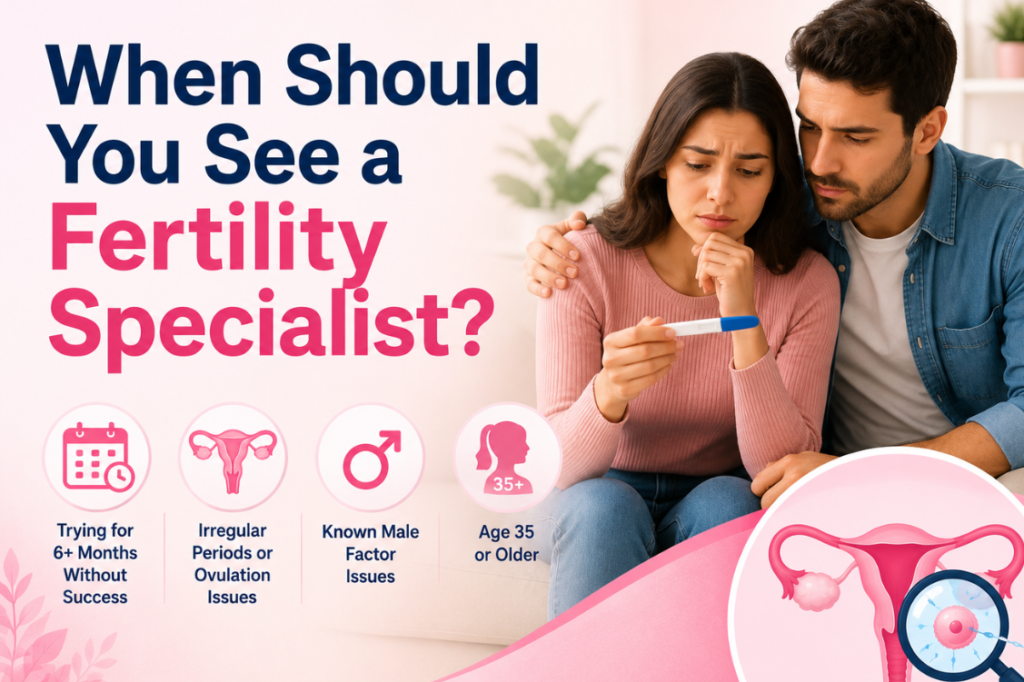
Quick answer: You should see a fertility specialist if you’ve been trying to conceive for 12 months without success and the woman is under 35, or for 6 months if she’s 35 or older. You should see one immediately, regardless of how long you’ve been trying, if there are known risk factors — irregular periods, PCOS, endometriosis, previous pelvic surgery, history of miscarriage, male partner with low sperm count, or known reproductive health issues. The single biggest mistake couples make is waiting too long. Fertility declines with age, and many treatable causes become harder to treat the longer they go undiagnosed.
If you’re wondering whether you’re “overreacting” by seeing a fertility specialist after 6 months — you’re not. If anything, you’re probably already late. This guide explains the medical rules around when to seek help, the warning signs that warrant earlier consultation, what a first visit actually involves, and the myths that keep couples waiting when they shouldn’t be.
The Standard Rule: 12 Months Under 35, 6 Months at 35 or Older
The standard medical definition of infertility is the inability to conceive after 12 months of regular, unprotected intercourse. This was set when most couples started having children in their mid-20s, when fertility decline isn’t yet a factor.
For women 35 or older, the timeframe is reduced to 6 months. Why? Because:
- Female fertility declines noticeably after 32 and sharply after 37
- Egg quality and quantity both decline with age
- Miscarriage rates rise with age
- Time spent “trying naturally” past 35 has a real cost — you have fewer good months left
For women 40 or older, many specialists recommend evaluation after just 3 months.
These are guidelines, not iron rules. They don’t apply to couples with known reproductive issues — which is the next section.
7 Signs You Should See a Fertility Specialist Sooner
If any of these apply, don’t wait the standard 12 months:
1. Irregular Periods or No Periods
Cycles longer than 35 days, shorter than 21 days, or completely absent suggest ovulation problems — meaning you may not be releasing eggs regularly. PCOS, thyroid disorders, hyperprolactinemia, and premature ovarian insufficiency all show up this way. If you’re trying to conceive with irregular periods, see a specialist now, not in 12 months.
2. Very Painful Periods
Severe menstrual pain that disrupts daily life, requires strong painkillers, or worsens over time can be a sign of endometriosis — a condition that significantly affects fertility but is often dismissed for years as “just bad cramps.” Endometriosis takes an average of 7–10 years to diagnose in India. Early evaluation can change that.
3. Known Reproductive Health Issues
You should see a fertility specialist immediately — before you even start trying — if you have:
- PCOS or PCOD
- Endometriosis
- Fibroids
- History of pelvic inflammatory disease
- Previous pelvic, abdominal, or ovarian surgery
- History of ectopic pregnancy
- Known tubal disease
PCOS is the most common of these in Hyderabad (https://pranawomenandfertility.com/pcos-treatment-and-infertility-hyderabad/) — and with the right pre-conception planning, most women with PCOS conceive.
4. You’re 35 or Older
Don’t wait 12 months at 35. Don’t wait 6 months at 38. Don’t wait at all at 40. Age is the single biggest determinant of female fertility. A 30-year-old has ~85% chance of conceiving within a year of trying. A 40-year-old has ~40% — and the chance falls each year.
5. Two or More Miscarriages
Recurrent pregnancy loss (RPL) is its own field. After two miscarriages — and definitely after three — you should see a specialist for evaluation. Investigations may include genetic screening, hormonal evaluation, uterine assessment, and immune workup.
6. Male Partner Has Any Known Risk Factor
You should see a specialist together if your male partner has:
- Previous testicular surgery (varicocele, hernia, undescended testis)
- History of mumps after puberty
- Chemotherapy or radiotherapy in the past
- Diabetes
- Significant weight gain
- Previous use of anabolic steroids or bodybuilding supplements
- Erectile or ejaculatory difficulties
Most male infertility is invisible without testing. Male factor accounts for 40–50% of infertility cases. (https://pranawomenandfertility.com/male-infertility-causes-tests-treatment/)
7. You “Just Know” Something Isn’t Right
This sounds unscientific, but it isn’t. Patients who feel something is wrong with their cycle, their body, or their fertility are usually correct. Trust that instinct enough to get a baseline evaluation. If everything is normal, you’ve lost nothing. If something is found early, you’ve gained years.
What Happens at a First Fertility Consultation?
Fear of the unknown keeps many couples from coming in. Here’s exactly what to expect:
Before the Visit The clinic will usually ask for:
- A list of medications you both take
- Past medical and surgical history
- Menstrual history (cycle length, regularity, last period date)
- Any previous fertility tests or treatments
During the Visit (Usually 45–60 minutes)
- Detailed history from both partners
- General examination
- Pelvic examination for the woman
- Discussion of lifestyle factors
- Explanation of the next-step workup
- Personalised plan, including timing
Tests Usually Ordered For the woman:
- AMH (anti-Müllerian hormone) — ovarian reserve marker
- FSH, LH, TSH, prolactin — hormone panel
- Pelvic ultrasound — uterus, ovaries, antral follicle count
- HSG or sonohysterography — tubal patency, if indicated
- HbA1c, vitamin D, vitamin B12
- HIV, hepatitis B/C, VDRL — required pre-treatment screening
For the man:
- Semen analysis
- Sometimes hormonal tests or scrotal ultrasound
What You’ll Walk Away With
- A clear understanding of what’s likely causing the delay
- A treatment plan with options (often 2–3 viable paths)
- A realistic timeline and cost estimate
- Lifestyle and supplement guidance to start immediately
A good first visit doesn’t push you into treatment. It gives you clarity and lets you choose.
Common Myths That Keep Couples Waiting
Myth 1: “We’ve only been trying for 8 months — it’s too early.”
If you’re under 35 and have no risk factors, yes — keep trying. If you have any risk factor (irregular periods, PCOS, endometriosis, age 35+, known male factor), 8 months is already late.
Myth 2: “We just need to relax and it’ll happen.”
Stress can affect fertility marginally — but the idea that “just relaxing” cures infertility is harmful. Real infertility causes (blocked tubes, endometriosis, low sperm count, ovulation problems) don’t resolve with relaxation.
Myth 3: “If we go to a fertility specialist, we’ll be pushed into IVF.”
A good fertility specialist will tell you when you *don’t* need IVF. Many couples need only lifestyle changes, ovulation induction, or IUI. The aim is to find the simplest treatment that works — not the most expensive.
Myth 4: “We’ll wait one more year before getting evaluated.”
This is the most costly mistake in fertility. A year of trying at 35 is not the same as a year at 30. Each year matters.
Myth 5: “Only the woman needs evaluation.”
40–50% of infertility involves a male factor. Both partners must be evaluated, ideally at the same visit. A semen analysis takes hours and costs less than a single ultrasound.
Myth 6: “I have regular periods, so I’m definitely ovulating.”
Regular periods are a good sign but not a guarantee. Anovulatory cycles can produce normal-feeling bleeding. Tracking with ovulation kits or a mid-luteal progesterone test confirms ovulation
Myth 7: “Fertility treatment causes cancer.”
Decades of large studies have not shown a clear link between fertility medications or IVF and cancer risk. The fertility medications you’ll take are well-studied.
Why Earlier Is Always Better
Three reasons early consultation matters:
- You may need no treatment at all. Many couples just need cycle tracking guidance, ovulation timing help, or basic lifestyle interventions.
- If treatment is needed, simpler treatments work better when started earlier. Lifestyle and ovulation induction work well in your early 30s. By 38, you often skip straight to IVF.
- You preserve options. Knowing your ovarian reserve at 33 lets you make informed choices about timing, egg freezing, or starting treatment.
The fertility specialist’s job is not to push you into treatment. It’s to give you information about your body so you can plan your life.
What to Look For in a Fertility Specialist
When choosing a fertility specialist in Hyderabad, look for:
- Formal qualifications in reproductive medicine (MS OBGY plus fellowship/specialisation in infertility)
- Experience with both simple and complex cases
- Transparent communication — willing to explain options, including the option to not start treatment yet
- Time given — first consultations should be unhurried
- Accessibility — will you be seeing the senior consultant or a junior?
- Lab quality — embryology lab standards matter for IVF outcomes
- Reviews and outcomes — not just from the clinic’s website
At Prana Women and Fertility Hospital (https://pranawomenandfertility.com/about_us/), Dr. Shirisha Reddy Varna brings MBBS, MS (OBGY), FRM, FAMS, MRCOG-1 (UK), DCU (Kiel, Germany), and a Fellowship in Infertility, with over a decade of experience and 5,000+ patients guided through fertility, pregnancy, and women’s health.
Don’t Wait Longer Than You Need To
If you’ve read this far, you’re already thinking about it. That instinct usually means it’s time.
At Prana Women and Fertility Hospital, Miyapur, we offer comprehensive first consultations with Dr. Shirisha Reddy Varna, including a full review of your history, examination, personalised workup plan, and clear next-step guidance — without rushing you into anything. Call (+91) 98858 51333 or book an appointment.
About the Author
Dr. Shirisha Reddy Varna is a Gynecologist and Fertility Specialist at Prana Women and Fertility Hospital, Miyapur, Hyderabad. She holds an MBBS, MS (OBGY), FRM, FAMS, MRCOG-1 (UK), DCU (Kiel, Germany), and a Fellowship in Infertility. She has supported over 5,000 women through their reproductive health journeys.
Frequently Asked Questions
If the woman is under 35, try for 12 months before consulting a fertility specialist. If she is 35 or older, consult after 6 months. If she is 40 or older, consult after just 3 months. If you have any known risk factor (PCOS, endometriosis, irregular periods, male factor history), consult immediately.
A gynecologist treats general women’s reproductive health. A fertility specialist has additional training in reproductive medicine, infertility evaluation, and assisted reproductive techniques like IUI and IVF. For fertility evaluation, see a specialist with formal infertility training.
Yes. Roughly half of infertility cases involve a male factor, and treatment decisions affect both partners. The first consultation goes much better when both partners attend.
A first fertility consultation in Hyderabad typically costs ₹500–₹1,500. Basic diagnostic tests (AMH, hormonal panel, semen analysis, ultrasound) usually add ₹4,000–₹10,000 depending on the package.
No. A good fertility specialist will recommend the simplest treatment likely to work. Many couples need only lifestyle changes, cycle monitoring, or ovulation induction. IVF is recommended only when simpler options aren’t suitable or have failed.
Yes. Many couples come for a baseline evaluation even without trying yet — especially women over 30 who want to know their AMH and ovarian reserve before planning. This is increasingly common and very reasonable.
Prana Women and Fertility Hospital in Miyapur (https://pranawomenandfertility.com/) is led by Dr. Shirisha Reddy Varna, a gynecologist and fertility specialist with a fellowship in infertility. Call (+91) 98858 51333 or book online for a consultation.