
Written by Dr. Shirisha Reddy Varna — Fertility Specialist & Gynecologist, Prana Women and Fertility Hospital, Miyapur, Hyderabad
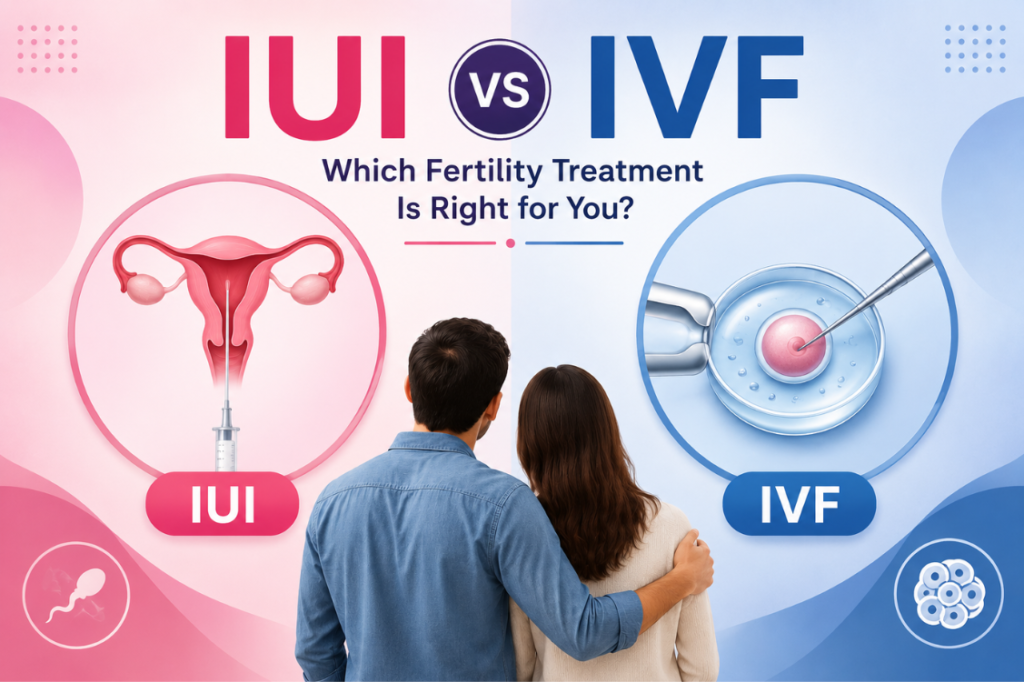
Quick answer: IUI (Intrauterine Insemination) and IVF (In-Vitro Fertilization) are two different fertility treatments with very different success rates, costs, and uses. IUI places washed sperm directly into the uterus around ovulation — it’s simpler, costs ₹15,000–₹35,000 per cycle, and works best for younger couples with unexplained or mild infertility (success rate: 10–20% per cycle). IVF combines eggs and sperm in a lab and places the embryo in the uterus — it costs ₹1.5L–₹3L per cycle but has a 40–60% success rate per cycle in women under 35. IUI is usually tried first; IVF is recommended when IUI fails, when there’s significant tubal/male factor/age-related infertility, or when time is critical.
If you’ve been told you need fertility treatment and are confused about which procedure to choose — or which to push back on — this guide walks through the real differences. We see couples every week at our Miyapur clinic who’ve been advised to “go straight to IVF” when IUI would have worked, and others who’ve burned through 5 unsuccessful IUI cycles when IVF should have been started after 3. The right answer depends on your specific case, not on a generic recommendation.
What Is IUI (Intrauterine Insemination)?
IUI is a fertility treatment in which prepared sperm is placed directly inside the woman’s uterus around the time of ovulation, bypassing the cervix to give sperm a head-start toward the egg.
The IUI process involves:
- Cycle monitoring — ultrasound scans track follicle growth, sometimes with mild ovarian stimulation using letrozole or clomiphene
- Trigger injection — given when the dominant follicle reaches mature size (~18mm)
- Sperm collection and washing — the male partner provides a sample on the day of IUI; the lab “washes” it to concentrate the healthiest, most motile sperm
- Insemination — the prepared sperm is introduced into the uterus through a thin catheter; the procedure takes about 5–10 minutes and is painless for most women
- Two-week wait — a pregnancy test is done 14 days later
IUI is essentially a “boosted natural cycle.” Fertilization still happens inside the body. The procedure helps when sperm need help reaching the egg — but it depends on the woman’s eggs, tubes, and uterus all working normally.
What Is IVF (In-Vitro Fertilization)?
IVF is a more involved fertility treatment in which eggs are retrieved from the ovaries, fertilized with sperm in a laboratory, and the resulting embryo is transferred back to the uterus.
The IVF process involves:
- Ovarian stimulation — daily hormone injections for 10–14 days to grow multiple mature eggs simultaneously
- Monitoring — frequent scans and blood tests during stimulation
- Trigger injection — when follicles are mature
- Egg retrieval (OPU) — a 20-minute procedure done under sedation, eggs are aspirated from follicles through a thin needle guided by ultrasound
- Fertilization in the lab — eggs and sperm are combined (or ICSI is done, injecting a single sperm into each egg)
- Embryo culture — embryos develop in the lab for 3–5 days
- Embryo transfer — one (sometimes two) healthy embryos are placed in the uterus through a thin catheter
- Luteal support — progesterone supplementation
- Pregnancy test at 12–14 days
IVF bypasses many natural barriers to conception. It works even when tubes are blocked, sperm count is very low, or eggs aren’t being released properly.
IUI vs IVF: Side-by-Side Comparison
| Factor | IUI | IVF |
| Cost per cycle (Hyderabad, 2026) | ₹15,000 – ₹35,000 | ₹1,50,000 – ₹3,00,000 |
| Time per cycle | 2–4 weeks | 4–6 weeks |
| Success rate per cycle (under 35) | 10–20% | 40–60% |
| Success rate per cycle (over 38) | 5–10% | 20–35% |
| Anaesthesia needed? | No | Yes (for egg retrieval) |
| Number of injections | 0–7 (optional stimulation) | 30–60 |
| Eggs used per cycle | 1–3 (natural ovulation) | 8–15 (stimulated retrieval) |
| Fertilization location | Inside the body | In the lab |
| Works with blocked tubes? | No | Yes |
| Works with severe male factor? | No (mild only) | Yes (with ICSI) |
| Genetic testing of embryos possible? | No | Yes (PGT-A/PGT-M) |
| Multiple pregnancy risk | 5–10% (twins) | 5–10% (single embryo transfer reduces this) |
| Typical recommendation | First-line for mild cases | When IUI fails or for severe cases |
When Is IUI the Right Choice?
IUI works best when the fertility issue is mild, the fallopian tubes are open, and the woman is under 35. Specifically, IUI is recommended when:
- Mild male factor infertility — slightly low sperm count or motility (not severe)
- Unexplained infertility — all tests normal but no pregnancy after a year of trying
- Cervical factor — hostile cervical mucus preventing sperm passage
- Mild PCOS — when ovulation has been restored with medication
- Single women or same-sex couples using donor sperm
- Couples with anti-sperm antibodies (mild)
- Sexual dysfunction or ejaculation issues
What you typically need for IUI to make sense:
- At least one open fallopian tube
- Reasonable sperm count (total motile sperm count >5 million after washing is ideal; >10 million gives better odds)
- Adequate ovarian reserve
- Normal uterine cavity
- Woman generally under 38
If these conditions are met, doing 3–4 IUI cycles before moving to IVF is reasonable and cost-effective.
When Is IVF the Right Choice?
IVF is the right choice when IUI either cannot work or has already failed. Specifically:
- Blocked or damaged fallopian tubes — IUI cannot work without functional tubes
- Severe male factor infertility — very low sperm count, poor motility, or azoospermia (requires ICSI with IVF)
- Advanced maternal age — generally women over 38, where IUI success drops sharply
- Diminished ovarian reserve — low AMH, time-critical situations
- Endometriosis (moderate to severe)
- Recurrent IUI failure — 3–4 IUI cycles without pregnancy
- Recurrent miscarriage — IVF with PGT-A can identify chromosomally normal embryos
- Genetic disorders in the family — IVF with PGT-M can screen embryos
- Fertility preservation — for cancer patients or social egg freezing
For couples in their late 30s or early 40s, IVF is often recommended directly because the time cost of failed IUI cycles is too high.
IUI vs IVF: Cost Reality Check in Hyderabad
The headline cost difference is large — but the real question is cost per live birth, not cost per cycle.
A 30-year-old woman with mild infertility starting IUI:
- IUI cost per cycle: ₹25,000
- Estimated cycles to pregnancy: 3 (cumulative success ~40–50%)
- Estimated total: ₹75,000
A 30-year-old woman starting IVF directly:
- IVF cost per cycle: ₹2,20,000
- Estimated cycles: 1–2
- Estimated total: ₹2,20,000–₹4,40,000
For this profile, IUI is clearly more cost-effective.
- IUI success per cycle: ~5%
- 4 failed IUI cycles: ₹1,00,000 + 4 months of declining fertility
- Then moves to IVF anyway: another ₹2,50,000+
- Total: ₹3,50,000+ with lost time
For this profile, going directly to IVF saves money and time.
The right answer requires honest evaluation of your individual case — not a default protocol.
Read our complete IVF cost breakdown for Hyderabad here: https://pranawomenandfertility.com/ivf-cost-in-hyderabad/
Side Effects and Risks: IUI vs IVF
IUI Risks
IUI is a low-risk procedure. Possible side effects include:
- Mild cramping during or after the procedure
- Light spotting
- Multiple pregnancy (5–10% chance of twins if stimulation was used)
- Rare pelvic infection (<1%)
- Very rare ovarian hyperstimulation if injectable stimulation was used
IVF Risks
IVF involves more medications and a minor surgical procedure, so risks are higher:
- Ovarian Hyperstimulation Syndrome (OHSS) — exaggerated response to fertility drugs; rare in well-managed protocols (1–3%)
- Egg retrieval risks — bleeding, infection, anaesthesia reactions (all rare, <1%)
- Multiple pregnancy — controlled by single embryo transfer
- Ectopic pregnancy (1–2%)
- Emotional and physical demand of the cycle
- OHSS-related hospitalisation in severe cases (very rare)
Both procedures are considered safe when performed by experienced specialists in accredited facilities.
How Do You Decide Between IUI and IVF?
Honest decision-making requires answering:
- What does the diagnostic workup show? A complete fertility workup (AMH, FSH, ultrasound, semen analysis, HSG for tubal patency) is the foundation.
- How old is the female partner? Time matters more after 35.
- How long have you been trying? Longer history shifts toward IVF.
- What’s your financial bandwidth? Honest planning prevents mid-treatment crisis.
- What does the fertility specialist actually recommend — and why? Don’t accept “IVF only” without explanation if your case might respond to IUI.
- What’s your emotional bandwidth? IVF is more demanding; some couples prefer fewer, higher-intensity attempts; others prefer gentler sequential cycles.
A good fertility specialist will lay out 2–3 viable paths, explain the trade-offs, and let you choose with full information.
Don’t Choose IUI or IVF Without a Full Workup
The right treatment isn’t decided by reading a blog — it’s decided after a full fertility workup that includes hormone testing, ultrasound, tubal evaluation, and a complete semen analysis. The same symptoms can point to very different treatment plans depending on what the tests show.
At Prana Women and Fertility Hospital, Miyapur, we offer complete fertility workups and clear, written treatment recommendations — including the option that’s most cost-effective for your specific case. Call (+91) 98858 51333 or book an appointment: https://pranawomenandfertility.com/#contact_us
About the Author
Dr. Shirisha Reddy Varna is a Gynecologist and Fertility Specialist at Prana Women and Fertility Hospital, Miyapur, Hyderabad. She holds an MBBS, MS (OBGY), FRM, FAMS, MRCOG-1 (UK), DCU (Kiel, Germany), and a Fellowship in Infertility.
Frequently Asked Questions
Yes. IUI in Hyderabad typically costs ₹15,000–₹35,000 per cycle, while IVF costs ₹1,50,000–₹3,00,000 per cycle. IUI is roughly 5–10 times cheaper per cycle but has lower success rates per attempt.
For women under 35, IUI has a 10–20% success rate per cycle and IVF has a 40–60% success rate per cycle. Success rates for both treatments decline with age, but IVF declines less steeply.
For most couples with mild infertility, open tubes, and reasonable sperm quality, 3 to 4 IUI cycles before moving to IVF is reasonable. For couples with blocked tubes, severe male factor infertility, or the woman over 38, going directly to IVF is usually recommended.
The general recommendation is 3 to 4 IUI cycles. Beyond 4 unsuccessful IUI cycles, the additional success rate is minimal, and continuing IUI delays a likely necessary move to IVF.
No. IUI is generally painless. Most women feel mild pressure or brief cramping similar to a Pap smear. No anaesthesia is needed.
If IUI is combined with ovarian stimulation, the chance of twin pregnancy is 5–10%, slightly higher than natural conception. Without stimulation, the twin rate is similar to natural conception.
Yes. Natural-cycle IUI (without stimulation) is an option for women with regular ovulation and normal ovarian reserve. Success rates are slightly lower but side effects are minimal.
Prana Women and Fertility Hospital in Miyapur offers complete the fertility workup, IUI, and IVF treatment under the Dr. Shirisha Reddy Varna. Call (+91) 98858 51333 to book a consultation. Learn more here: https://pranawomenandfertility.com/fertility-treatments/