
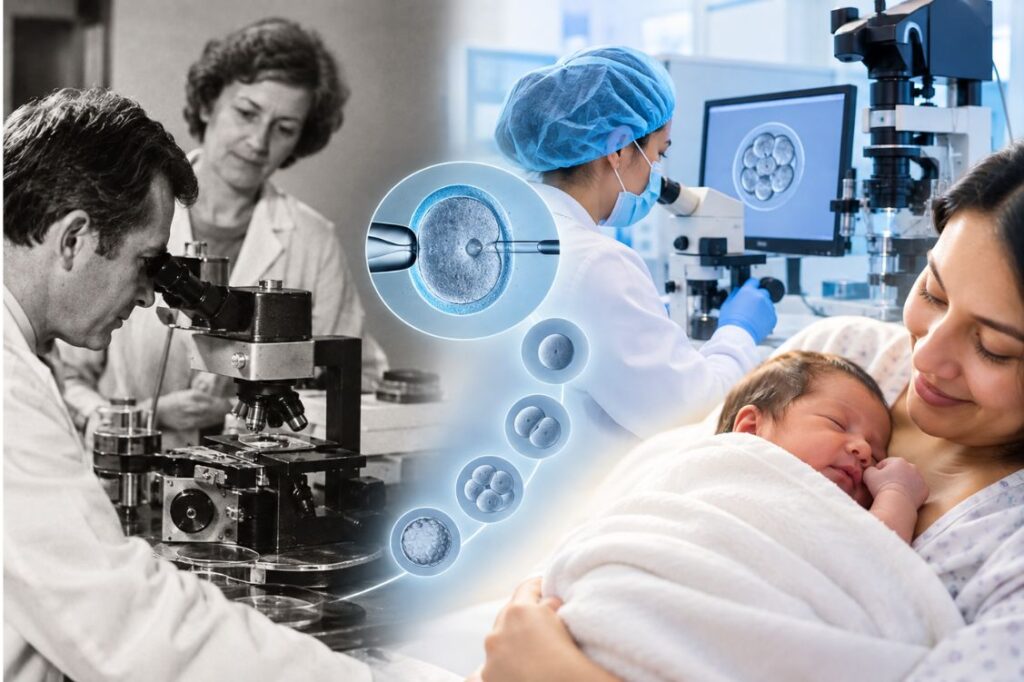
It’s easy to think of IVF as a well-established, almost routine medical procedure today — because for millions of families, that’s exactly what it’s become. But it wasn’t always this way. Understanding where IVF started makes it easier to appreciate just how much the science, and the odds, have improved since.
The World’s First Test-Tube Baby
Louise Brown was born in England in 1978, the result of the first successful IVF procedure, developed by Dr. Patrick Steptoe and Dr. Robert Edwards. At the time, the idea of fertilizing an egg outside the body and transferring the resulting embryo into the uterus was met with a mix of scientific fascination and public skepticism — this was genuinely uncharted territory, achieved after years of research with no guarantee it would ever work in a live birth. Robert Edwards was later awarded the Nobel Prize in Physiology or Medicine in 2010 for this work, decades after that first birth, once the long-term impact of the technology was fully evident.
India’s Early Entry Into IVF History
India’s first IVF baby, Kanupriya Agarwal (also known as Durga), was born in Kolkata in 1978 — remarkably, just weeks after Louise Brown, making India one of the earliest countries in the world to achieve a successful IVF birth. This early milestone, achieved by Dr. Subhash Mukhopadhyay working with limited resources compared to his UK counterparts, is a significant and sometimes under-recognized part of IVF’s global history.
Why the Early Days Were So Uncertain
The first successful IVF procedures involved none of the tools considered standard today. There was no ICSI for male infertility, no preimplantation genetic testing, no reliable embryo freezing, and vastly less understanding of optimal stimulation protocols. Success rates in the earliest years were a fraction of what they are now, and each pregnancy was, in a real sense, still part of ongoing research into whether and how the technology could be made reliable.
What’s Changed Since Then
Fertilization techniques: The development of ICSI in the early 1990s meant that male-factor infertility, previously one of the most difficult barriers to overcome, could be addressed directly by injecting a single sperm into an egg — a technique unavailable to the very first IVF patients.
Embryo assessment: Embryologists today can culture embryos to the blastocyst stage (day 5–6) rather than transferring at an earlier stage, allowing better selection of the embryos most likely to implant successfully — a capability that didn’t exist in IVF’s first years.
Genetic screening: Preimplantation genetic testing now allows embryos to be screened for chromosomal abnormalities before transfer, particularly valuable for older patients or those with a history of pregnancy loss — entirely unavailable to early IVF patients.
Freezing technology: Modern vitrification (rapid freezing) techniques for eggs and embryos have dramatically improved survival rates after thawing compared to older freezing methods, making frozen embryo transfer a highly effective option rather than a significant compromise.
Success rates broadly: Today’s IVF success rates, particularly for women under 35, are substantially higher than anything achievable in IVF’s first decade, reflecting improvements across stimulation protocols, lab conditions, and embryo selection collectively.
Why This History Is Worth Knowing as a Patient
Understanding how far the technology has come isn’t just a historical curiosity — it’s a useful reminder that today’s IVF bears only a distant resemblance to the uncertain, experimental procedure of 1978. Concerns rooted in outdated information — old success rate statistics, outdated protocols, stories from decades past — often don’t reflect what modern fertility treatment actually looks like.
What This Means for Patients Considering IVF Today
If part of your hesitation about IVF comes from a general sense of uncertainty about the technology, it’s worth knowing that you’re not stepping into the same unknown that early patients did. Decades of refinement, millions of successful births worldwide, and continuous technical improvement stand behind the version of IVF available today — a genuinely different starting point than the one Louise Brown’s parents faced in the 1970s.
Frequently Asked Question
Estimates suggest well over 10 million babies have been born through IVF and related assisted reproductive technologies worldwide since 1978, reflecting how thoroughly the technology has become an established part of modern fertility care.
Extensive research over more than four decades has generally found IVF-conceived children to have health outcomes comparable to naturally conceived children, though as with any pregnancy, individual risk factors vary and are best discussed with your specialist.
Early success rates were low, and it took years of refining stimulation protocols, lab techniques, and embryo culture methods before IVF became reliable and accessible enough to become a standard fertility treatment option worldwide.
Yes — refinements in embryo culture, genetic screening, and freezing technology have continued to improve outcomes even within relatively recent years, meaning IVF technology from a decade ago already differs meaningfully from what’s available today.